
Salajeet for Brain & Memory — Focus, Cognition & the Alzheimer's Research (Dimagh ke liye Salajeet)
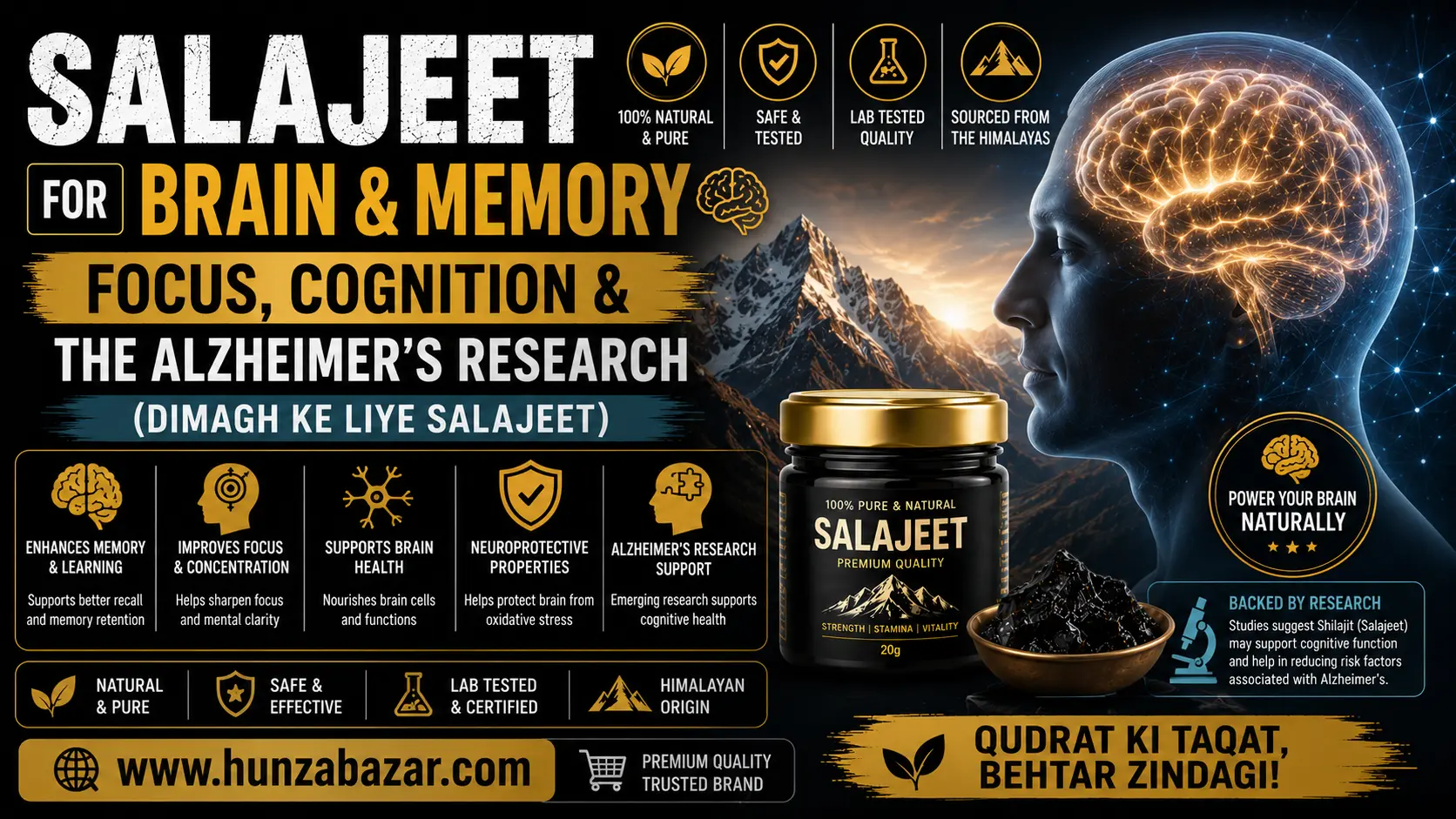
Two very different people search for this: a student trying to focus before exams, and a family worried about an elder's fading memory. Both land on the same ancient name — salajeet (shilajit), long used as a dimagh tonic. As a Gilgit-Baltistan team that sources salajeet at its origin, here's the honest picture: what salajeet may do for the brain, what the much-talked-about Alzheimer's research actually says, and where it stops. This is the brain chapter of our complete salajeet guide.
Quick answer: Salajeet's main compound, fulvic acid, is an antioxidant that reaches the brain, and in laboratory studies it can block the clumping of tau protein — a hallmark of Alzheimer's. It's traditionally used for focus and memory. But human evidence is early, and salajeet is not a cure or treatment for any brain condition.
Salajeet aur Dimagh — How It May Support the Brain
The brain is an energy monster — about 2% of body weight but roughly 20% of the oxygen you use. Salajeet may help on two fronts here.
First, energy: its dibenzo-α-pyrones and fulvic acid support the mitochondria, the cell's power plants, which matters for an organ this energy-hungry. Second, protection: fulvic acid is a strong antioxidant that crosses into the brain and helps reduce the oxidative stress and inflammation linked to cognitive decline. That's the plausible basis for salajeet's reputation — though, as you'll see, "plausible" isn't the same as "proven in people."
The Tau-Protein & Alzheimer's Research — Honestly
This is the science people quote, so let's get it right. In Alzheimer's, a protein called tau becomes faulty and clumps into tangles that damage neurons. A review in the International Journal of Alzheimer's Disease (Carrasco-Gallardo et al., 2012) reported that fulvic acid can block tau from self-aggregating in laboratory studies. A 2023 lab study went further, with certain Andean-shilajit fractions cutting tau aggregation by around 76%.
There's even one small human signal: a 24-week trial in 16 patients with probable Alzheimer's found that a shilajit-plus-B-vitamin formula led to less cognitive decline than placebo.
Now the honest part. These are lab studies and one tiny trial of a combination product — not proof that salajeet treats or prevents Alzheimer's. Researchers themselves call for proper clinical trials. As one neutral source puts it, shilajit is not a cure or treatment for neurodegenerative disease; the interest is in possible prevention, alongside a healthy lifestyle. If memory loss is a real concern, see a doctor — not a supplement aisle.
For Students — Focus & Studying
Salajeet is popular with students for mental energy and focus during heavy study periods, thanks to that antioxidant and mitochondrial support. Imtihaan se pehle many reach for it.
Be realistic, though: salajeet is not a magic exam pill. No supplement beats the basics — proper sleep, good food, hydration and actual practice drive exam performance far more than any resin. And a clear rule: anyone under 18 should not take salajeet. For school-age students, focus entirely on the fundamentals. Adult students who want to try it can see our dose guide and our note on the best time to take it around study sessions.
For Older Adults — Memory & Brain Aging
For elders, salajeet's appeal is its antioxidant support for healthy brain aging. Reducing oxidative stress may, in theory, support clearer thinking over time.
But there's a firm line here too: ordinary forgetfulness is one thing; genuine memory loss, confusion or personality change needs a proper medical check. Salajeet may be a supportive add-on with a doctor's okay — never a substitute for diagnosis and care.
Salajeet + Walnuts — A Natural Brain-Food Pairing
If you want a food partner, reach for walnuts (akhrot). They're one of the richest plant sources of ALA omega-3 and polyphenols, both linked to brain health — and yes, the nut even looks like a little brain. Salajeet alongside brain-supporting foods makes more sense than either alone. Browse our Hunza walnuts to add them in.
How to Take It, Buy Real & Stay Safe
Keep it simple: 300–500 mg a day — a rice-grain-sized piece — in warm (not boiling) water or milk, taken consistently, since any cognitive benefit builds slowly.
Genuine salajeet dissolves fully in warm water and bubbles without burning; fakes (coal, tar) don't. To avoid the guesswork, our sun dried Aftabi salajeet is processed to protect its fulvic acid. Avoid salajeet if you're under 18, pregnant or breastfeeding, or on regular medication without a doctor's okay — and remember that untested salajeet can carry heavy metals.
Conclusion
Salajeet has a real, interesting basis for brain support — antioxidant protection, brain-cell energy, and lab research on tau protein that scientists are keen to explore. But keep expectations honest: it's a possible support for healthy brain aging and focus, not a treatment for Alzheimer's or a shortcut to top exam marks. Pair it with good sleep, brain-friendly foods, and a doctor's advice for any real concern. Explore our pure shilijit range to learn more. Yaaddasht ka masla ho to doctor se zaroor miley.
Frequently Asked Questions
Does salajeet improve memory and focus?
Kya salajeet dimagh tez karti hai?
Does salajeet help or cure Alzheimer's?
Can students take salajeet for exams?
Salajeet dimagh ke liye kaise lein?
Share this post:


