
Karakoram vs Himalayan Salajeet — Which Is Better? (Pakistani vs Indian/Nepali)
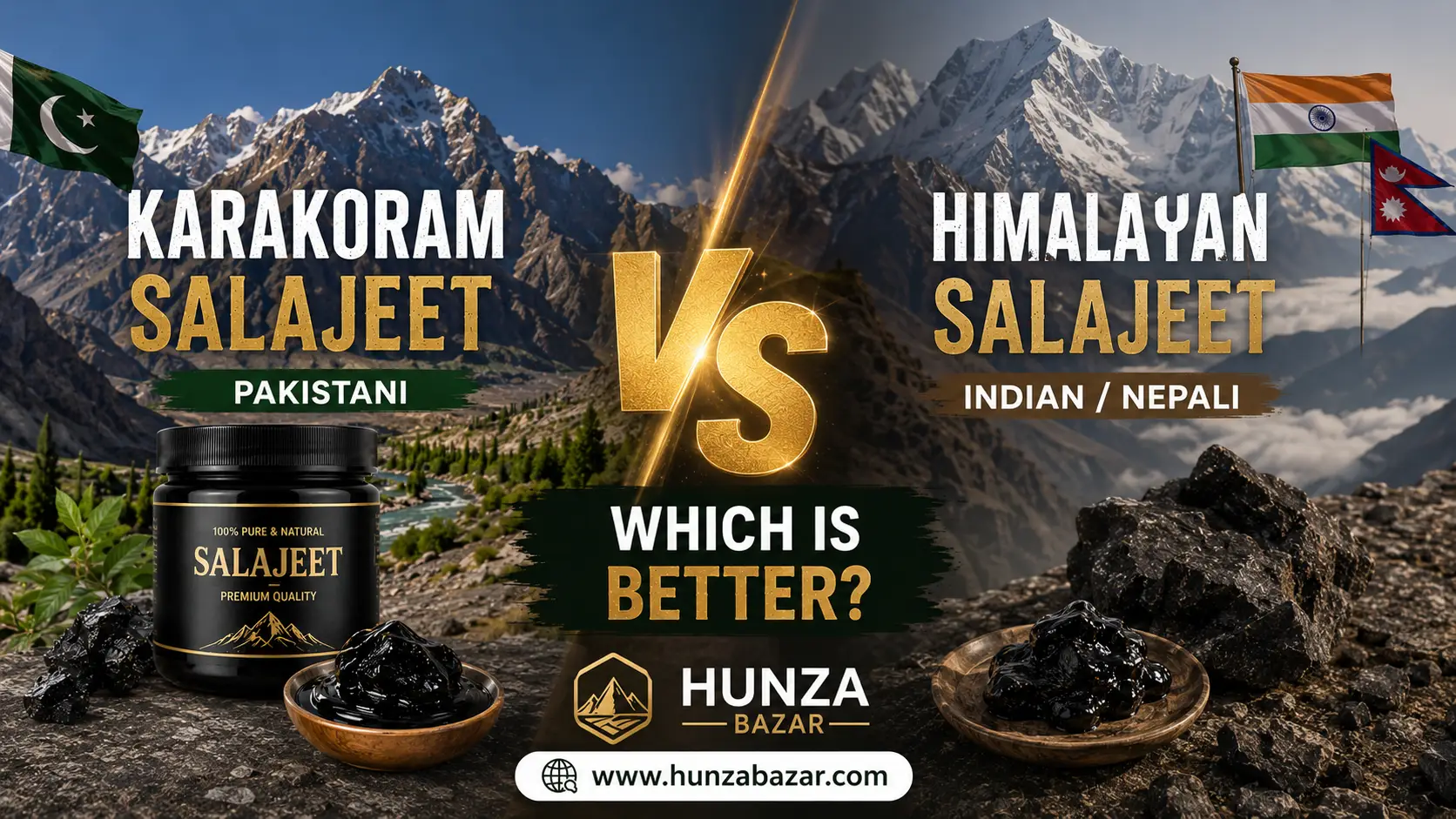
You'll see "Himalayan shilajit" on labels everywhere — but is it actually better than Pakistan's Karakoram salajeet? The honest answer is more interesting than the marketing suggests. As a Gilgit-Baltistan team that sources salajeet from the Karakoram, here's a fair comparison of the ranges, the altitude, and the one thing that truly decides quality. This sits within our complete salajeet guide.
Quick answer: Both the Karakoram (Pakistan) and the Himalayas (India, Nepal) produce genuine, high-quality salajeet. Pakistan's Karakoram is among the highest-altitude sources on Earth, making its salajeet at least the equal of any Himalayan one. But the real decider isn't the range or the country — it's the specific source, purity and lab-testing.
Karakoram vs Himalayas — Two Different Ranges
First, a fact many people miss: the Karakoram and the Himalayas are two separate ranges. The Karakoram — home to K2, the world's second-highest peak — sits in northern Pakistan's Gilgit-Baltistan, just north of the western Himalayas.
The Himalayas proper stretch across India, Nepal, Bhutan and Pakistan's west (where Nanga Parbat stands). So in truth, Pakistan produces both Karakoram and western-Himalayan salajeet — "Karakoram vs Himalayan" is really about source regions, not Pakistan versus everyone else.
The "Himalayan Shilajit" Label — What It Really Means
Here's an honest surprise: "Himalayan shilajit" is largely a marketing umbrella. Most salajeet sold in the West as "Himalayan" actually traces to India, which has the largest commercial supply — yet the same label is often slapped on Pakistani and Karakoram resin too.
In other words, the word "Himalayan" tells you less than you'd think. It's a branding term, not a quality guarantee. What matters is the actual, named source and whether it's been tested.
Where Each Type Comes From
A fair regional rundown:
- Pakistan (Gilgit-Baltistan — Hunza, Skardu): among the highest-altitude commercially harvested salajeet, from Karakoram-area collectors.
- India (Ladakh, Himachal, Uttarakhand): the largest supply with the widest quality range — Ladakh can match Pakistani altitudes, while Himachal and Uttarakhand sit lower.
- Nepal (Dolpa, Mustang, Manang): smaller volume, traditional harvesting, generally high quality when you find it.
The Altitude Question — The Karakoram's Edge
This is where Pakistan's salajeet has a genuine case. The Karakoram holds the greatest concentration of extreme high peaks anywhere, and Pakistani GB salajeet forms at some of the highest elevations harvested — conditions traditionally linked to potent, mineral-dense resin.
That said, honesty matters: it's an edge, not a monopoly. Indian Ladakh sits at similar altitudes, and Nepali sources are high quality too. The Karakoram gives Pakistani salajeet a strong starting advantage — not an automatic crown.
Is Pakistani Salajeet Higher in Fulvic Acid?
This is the claim you'll see most, so here's the honest truth: fulvic acid content varies by the specific source and even the individual batch — not by country or range. Genuine high-altitude salajeet from the Karakoram, the Indian Himalayas or Nepal is all fulvic-rich.
A couple of honest cautions: reliably documented fulvic levels in authentic salajeet sit in a moderate range, and any product claiming 70%+ fulvic acid should raise an eyebrow about accuracy. So no honest seller — Pakistani or otherwise — can claim their country is categorically "more fulvic." Only a batch-specific lab report can actually tell you.
Karakoram vs Himalayan — At a Glance
| Karakoram (Pakistan) | Himalayan (India / Nepal) | |
|---|---|---|
| Range | Karakoram (K2) | Himalayas |
| Altitude | Among the highest on Earth | Very high (Ladakh matches; others lower) |
| Main sources | Pakistan — GB (Hunza, Skardu) | India (largest supply), Nepal |
| Fulvic acid | Rich — varies by batch | Rich — varies by batch |
| What decides quality | Purity + lab-testing | Purity + lab-testing |
So Which Should You Choose?
Both are genuinely excellent. Pakistani Karakoram salajeet is at least the equal of any Himalayan salajeet, with a real altitude advantage — a world-class choice by any measure. But choose it for the right reason: not the flag or the range on the label, but purity, lab-testing and a transparent, named source. A lab-tested Karakoram resin like our Aftabi salajeet gives you that confidence. Learn more about its Hunza origin and all of Pakistan's sources — or see how salajeet compares to other supplements.
Conclusion
In the Karakoram-versus-Himalayan debate, there's no need for national rivalry: both ranges yield superb salajeet, and Pakistan's high-altitude Karakoram resin stands shoulder to shoulder with the best in the world. The honest takeaway is to look past the label — "Himalayan" or "Karakoram" — and judge salajeet by its purity, its batch lab report, and a source willing to name itself. That's how you get the real thing. Explore our lab-tested pure salajeet range. Naam nahi — purity aur lab report ahem hai. 🏔️
Frequently Asked Questions
Is Karakoram salajeet better than Himalayan?
Is Pakistani salajeet better than Indian or Nepali?
What's the difference between Karakoram and Himalayan shilajit?
Does Pakistani salajeet have more fulvic acid?
Is Himalayan shilajit always from the Himalayas?
Share this post:


