
Hunza Salajeet — Gilgit-Baltistan's Mountain Treasure
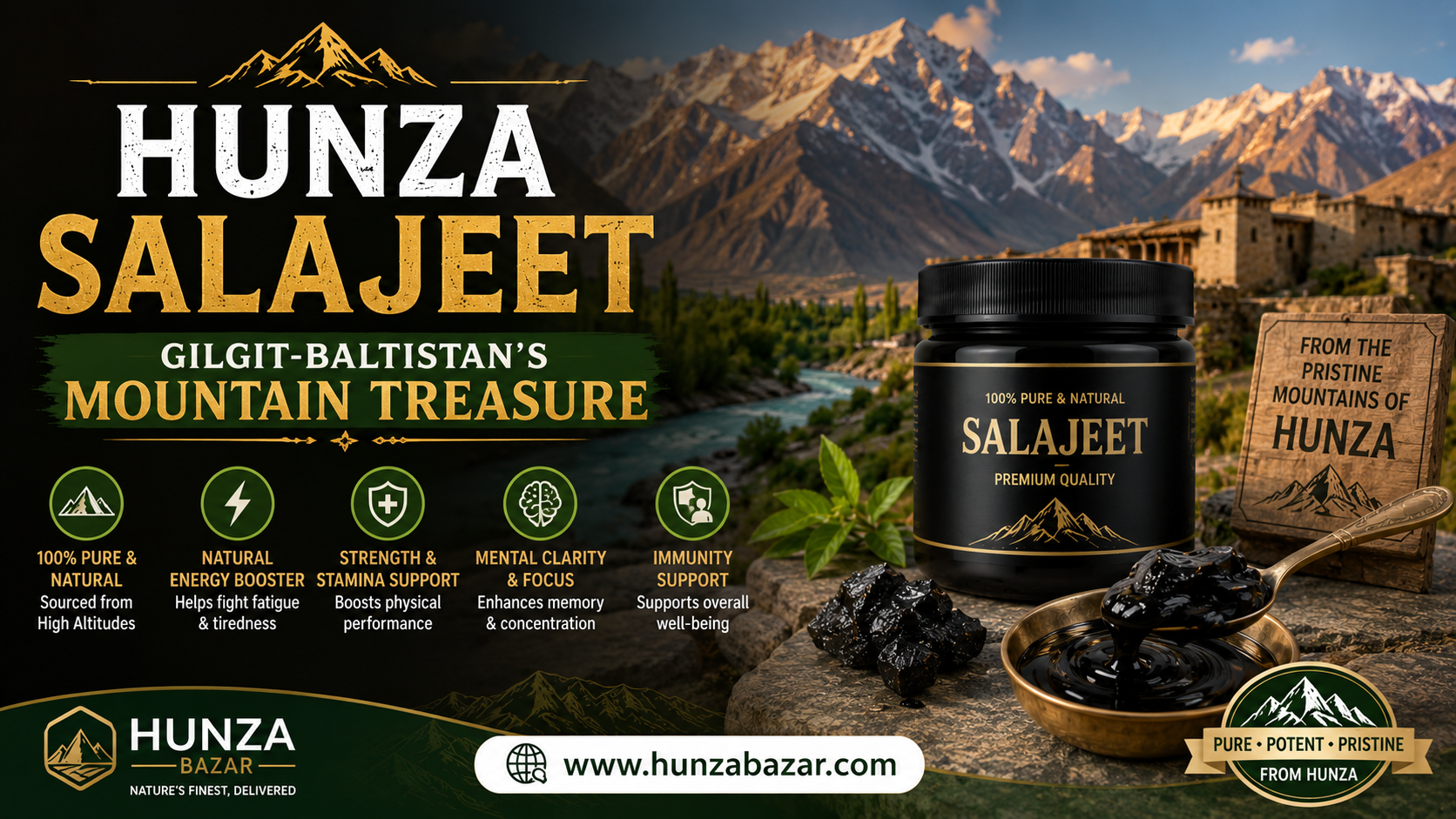
High in the Karakoram mountains of Gilgit-Baltistan, where some of the tallest peaks on earth pierce the sky, a dark resin seeps from ancient rock each summer. This is salajeet — the "conqueror of mountains, destroyer of weakness." As a team based in Gilgit-Baltistan, this isn't a story we read about; it's our home and our heritage. Here's where Hunza salajeet truly comes from, how nature makes it over centuries, and why it's so treasured. This sits within our complete salajeet guide.
Quick answer: Hunza salajeet is shilajit from the high Karakoram mountains of Gilgit-Baltistan in northern Pakistan — recognised globally, including by Encyclopaedia Britannica, as one of the world's primary sources. It forms over centuries as plant matter compresses between high-altitude rocks, and is hand-collected from crevices in summer. Its remote, mineral-rich origin is why it's so prized.
Where Hunza Salajeet Comes From
Gilgit-Baltistan sits at the meeting point of three great ranges — the Karakoram, the Himalayas and the Hindu Kush — home to K2 and some of the most rugged, pristine terrain on the planet. It's here, in the high rock faces above the valleys, that salajeet is found.
This isn't a marketing claim: Encyclopaedia Britannica lists "the mountains of the Gilgit-Baltistan region of Pakistan" among the world's primary shilajit sources, alongside the Himalayas, Altai and Caucasus. For us in GB, it's simply pahaaron ka tohfa — the mountains' gift.
How Salajeet Forms — Nature's Centuries-Long Work
Salajeet is not manufactured; it is grown by the mountains over centuries. The process is slow and remarkable:
Over hundreds of years, plants, mosses and other vegetation die and are broken down by microbes — a process called humification. This decomposing organic matter mixes with minerals leached from the surrounding rock, and is then compressed and preserved under layers of rock under immense geological pressure.
The result is a resin rich in fulvic acid and trace minerals. At altitudes between roughly 1,000 and 5,000 metres, it seeps out from cracks in the rock during the warm summer months, when it softens enough to be collected. Centuries of nature, in a single drop.
Why Altitude Matters
Here's where Gilgit-Baltistan's geography gives salajeet its edge. The extreme high-altitude environment — intense cold, dramatic day-to-night temperature swings, mineral-rich rock, and clean, pollution-free air — is believed to slow the decomposition process, helping the salajeet retain its bioactive compounds and concentrated minerals. In Pakistan, the best salajeet is often sourced from elevations above 12,000 feet.
Honestly, though, altitude only gives salajeet a head start. Purity and careful processing decide the final quality — which is why where it comes from and how it's handled both matter.
What Makes Gilgit-Baltistan Salajeet Special — At a Glance
In short, GB salajeet's reputation rests on a few genuine advantages:
- Extreme altitude — sourced from remote elevations, often above 12,000 feet.
- Mineral-rich rock — the Karakoram's geology feeds its trace-mineral content.
- Clean, pollution-free air — a pristine, untouched environment.
- Hand-collected at source — gathered traditionally, not mass-produced.
- Verified by testing — the best is always lab-tested for purity.
The Harvesters — Hand-Collected from the Peaks
Behind every jar is real human effort. Each summer, skilled local harvesters climb into rugged, often inaccessible high terrain to find salajeet seeping from rock crevices, and carefully scrape the raw resin away by hand.
It's demanding, sometimes dangerous work that takes deep knowledge of the mountains, precision to avoid contamination, and patience. These are people who know these peaks intimately — and that human skill is part of what makes genuine GB salajeet rare and special.
From Raw Rock to Pure Resin
One honest truth: salajeet straight off the rock is not ready to use. Raw resin carries soil, bits of rock and other impurities, so it must be carefully cleaned and purified — traditionally by dissolving it in water, filtering out debris, and gently drying it back into a pure, solid resin.
This step is where quality is made or lost. Our Aftabi salajeet is naturally sun-processed to preserve its compounds — we explain exactly how in our Aftabi processing guide.
Why Choose Hunza Bazar's Salajeet
We don't source our salajeet from a distant supplier — we're from Gilgit-Baltistan. This is our home, and our salajeet is hand-collected at origin in these mountains, carefully processed, and lab-tested for purity.
In a market flooded with fakes and adulterated resin (see our real vs fake guide), that origin and that testing are everything. When you choose us, you're getting the real mountain treasure — traceable, pure, and from the people who live where it forms. Explore our pure salajeet range and taste the difference of genuine GB salajeet.
Hunza vs Pakistan's Other Sources
Gilgit-Baltistan is Pakistan's most renowned salajeet region, but it isn't the only one — salajeet is also found in Chitral and other northern areas, each with its own character. We map them all in our Pakistan salajeet sources guide, and compare the great ranges in our Karakoram vs Himalayan salajeet guide. Wherever it's from, the rule never changes: always verify purity.
Conclusion
Hunza salajeet is more than a supplement — it's centuries of the Karakoram, gathered by hand from the rock. Formed slowly at extreme altitude, hand-collected by people who know these peaks, and carefully purified, genuine Gilgit-Baltistan salajeet carries the strength of the mountains it comes from. As a team rooted right here in GB, we're proud to bring you the real thing — pure, lab-tested, and traceable to its source. Explore our pure salajeet range. Pahaaron ka asli tohfa — seedha Gilgit-Baltistan se aap tak. 🏔️
Frequently Asked Questions
What is Hunza salajeet?
Where does salajeet come from in Pakistan?
How is salajeet formed?
Why is Gilgit-Baltistan salajeet considered the best?
Kya Hunza salajeet asli hoti hai?
Is Gilgit-Baltistan salajeet pure?
Share this post:


