
Salajeet for Fertility — Men's Sperm Health & Women's Reproductive Wellness (Aulad ke liye Salajeet)
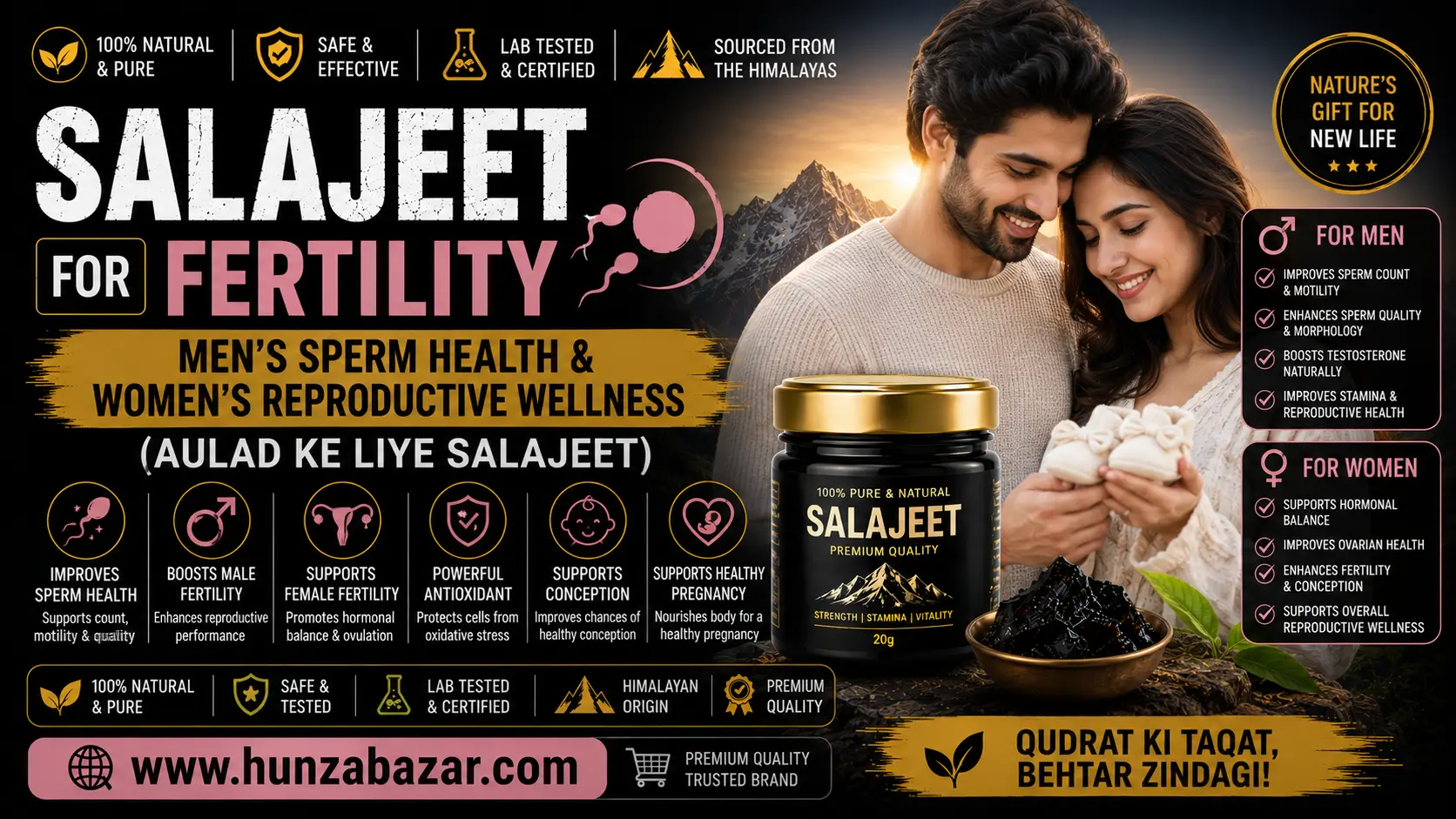
Waiting and hoping for a child (aulad) is one of life's hardest journeys, and many couples in Pakistan look for natural help along the way. Salajeet (shilajit) has a long reputation as a fertility tonic, so it comes up often. As a Gilgit-Baltistan team that sources salajeet at its origin, we owe you complete honesty here — gently, but without false hope. Here's what the research really shows for men and women, and the safety line that matters most. This is the fertility chapter of our complete salajeet guide.
Quick answer: For men, one clinical study suggests salajeet may improve sperm count, motility and quality in cases of low sperm count. For women, there is little direct fertility evidence. It is not a guaranteed treatment or a cure for infertility — and it must not be taken during pregnancy. Real infertility needs a doctor.
⚠️ Read this first: If you're trying to conceive and could already be pregnant, do not take salajeet — it isn't considered safe in pregnancy. Stop the moment you might be expecting.
Infertility in Pakistan — A Sensitive Subject
Infertility is more common than people admit, and in our culture it often comes with unfair stigma and blame — usually aimed at the woman. The first honest truth: infertility is a shared medical issue, and in roughly half of couples a male factor is involved.
So the right first step isn't a supplement — it's a proper check-up for both partners. Salajeet may have a supportive role in one specific area (male sperm quality), but it isn't a cure, and it shouldn't replace seeing a doctor together.
For Men — The Sperm-Quality Research
This is where salajeet has its most real evidence. In a clinical study (Biswas et al., 2010), men with low sperm count took purified shilajit for 90 days and showed meaningful improvements: total sperm count rose about 61%, motility and normal sperm shape (morphology) improved, and a marker of oxidative damage to sperm dropped by around 19%.
That last point explains the likely mechanism: oxidative stress harms sperm, and salajeet's fulvic-acid antioxidants may help protect them. Honest caveats, though: this was a small, short study in men with low counts — not proof for everyone, and not a guarantee of pregnancy. Male infertility has many causes (hormonal, structural, genetic) that salajeet can't fix. (For the testosterone side, see our salajeet for men guide.)
For Women — An Honest Look
Here we have to be straight: there is little to no direct clinical evidence that salajeet improves female fertility. Claims about "balancing hormones" for women are largely traditional, not proven, and salajeet is not a treatment for female infertility or conditions like PCOS.
On top of that, the pregnancy concern (below) makes salajeet a poor fit for women actively trying to conceive. If you're a woman facing fertility challenges, the honest advice is to see a gynaecologist rather than rely on a resin. Our salajeet for women guide has more on general use and cautions.
⚠️ Pregnancy — The Critical Safety Rule
This is the most important point in the whole article. Salajeet must not be taken during pregnancy or breastfeeding. Its safety in pregnancy has not been established, and raw or impure resin can carry heavy metals that are especially risky for a developing baby.
For couples trying to conceive, this creates a clear rule: a woman who might be pregnant should not take salajeet, and should stop immediately if there's any chance she's expecting. When in doubt, leave it out. See our full list in who should not take salajeet.
Salajeet Is Not a Fertility Cure — Honest Expectations
Please hold on to this, because hope can be exploited. Better sperm numbers on a lab report are not the same as a guaranteed pregnancy, and salajeet does not cure infertility.
Infertility has many possible causes in either partner, and some need real medical treatment — from hormone therapy to IVF or ICSI. The kindest, most honest advice we can give is this: don't delay proper medical help while chasing supplements. See a fertility specialist, get both partners evaluated, and treat salajeet as — at most — a supportive extra for male sperm quality, with a doctor's okay.
How Men Might Use It — With a Doctor
If a man wants to try it as support (and his doctor agrees), the practical details: a typical dose is around 300–500 mg a day of pure resin in warm water or milk, taken consistently. Give it 2–3 months, because sperm take roughly 74 days to mature — so changes, if any, take months, not weeks.
Only real salajeet is worth using: genuine resin dissolves fully in warm water and bubbles without burning; fakes (coal, tar, wax) don't. Our sun-dried Aftabi salajeet is processed to protect its fulvic acid.
A Brief Islamic Note
Many readers ask whether salajeet is permissible and how Islam views seeking help for aulad. In short: salajeet is a natural substance generally considered permissible, and Islam encourages seeking treatment (taking the means) alongside trust in Allah. We cover this respectfully and in full in our Islamic perspective on salajeet.
Conclusion
Salajeet's fertility story is real but narrow: genuine, if early, evidence that it may improve sperm quality in men with low counts — and very little beyond that, especially for women. Treat it as a possible support for the male side, never a cure, never a reason to delay real medical help, and never something to take if pregnancy is possible. Get both partners checked, choose pure, lab-tested resin if you proceed, and let a doctor guide you. Explore our pure salajeet range to learn more. Aulad ke liye dono mian-biwi ka doctor se checkup zaroori hai.
Frequently Asked Questions
Does salajeet increase fertility?
Kya salajeet se khany aulad hoti hai?
Does salajeet increase sperm count?
Can women take salajeet for fertility?
Is salajeet safe during pregnancy?
Does salajeet cure infertility?
Share this post:


