
Salajeet for Women — Iron, Hormones & Energy: The Honest Guide (Auraton ke liye Salajeet)
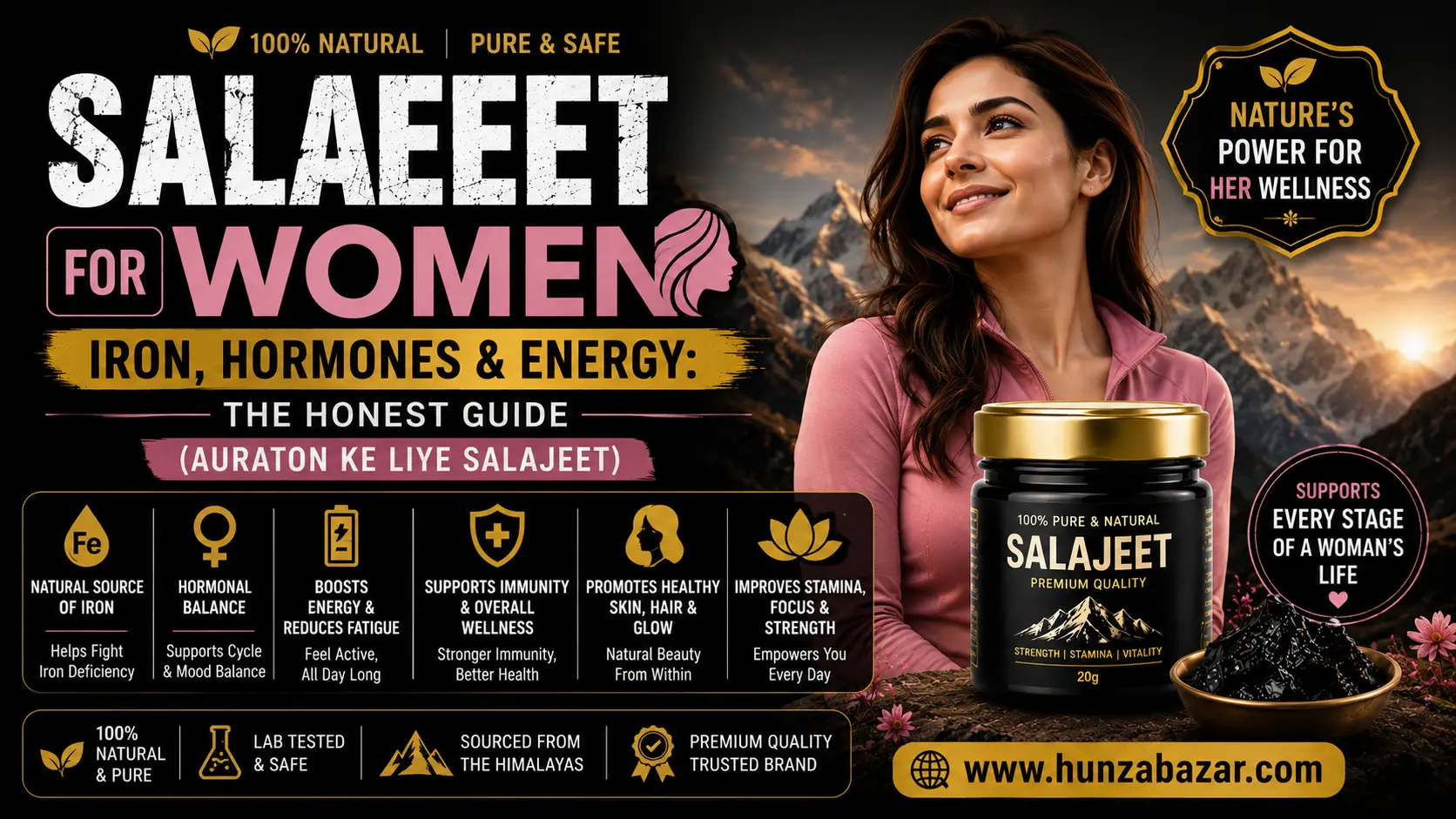
Salajeet is usually marketed to men — but Pakistani women have real reasons to look at it too. With anaemia and low energy so common, thakaawat aur kamzori are everyday complaints. Salajeet (shilajit) is a mineral-rich mountain resin that can support women's energy and bone health. But there are important caveats — including one firm rule: it must not be taken during pregnancy. Here's the honest, women-specific guide from our Gilgit-Baltistan team. This is the women's chapter of our complete salajeet guide.
Quick answer: Salajeet may support women's energy, bone density and mineral levels, thanks to its fulvic acid and iron. The strongest evidence is for bone health after menopause. But it can raise testosterone — not ideal for every woman — and it must be avoided in pregnancy and breastfeeding. It's a supplement, not a treatment for anaemia or any condition.
Salajeet Auraton ke Liye — What It Can (and Can't) Do
For women, salajeet's appeal comes from its makeup: fulvic acid, humic acid, and trace minerals like iron, magnesium, and calcium. The fulvic acid helps carry those minerals into your cells.
That can support steady energy and, as you'll see, bone health. But "good for women" is not one simple story — some of salajeet's effects suit certain women and not others. So let's go, honestly, area by area.
Iron, Anaemia & Energy — The Honest Picture
This is the big one for Pakistani women. The National Nutrition Survey (2018) found that about 42–43% of women aged 15–49 are anaemic — roughly four in ten — mostly due to iron deficiency. (The figure was around 50% in 2011, so it's improving, but still high.)
Salajeet does contain iron and is traditionally used for energy and kamzori. Here's the honest part, though: salajeet is not a treatment for anaemia. Its iron is small and variable — nowhere near a medical iron dose. If you're constantly tired, get a simple blood test; genuine iron-deficiency anaemia needs proper iron therapy from a doctor, not a resin. And because salajeet adds iron, women with iron-overload conditions should avoid it.
Bones & Menopause — Where the Evidence Is Strongest
Here, the science is most solid. In a randomised, double-blind, placebo-controlled trial (Pingali & Nutalapati, 2022), 60 postmenopausal women aged 45–65 with osteopenia took shilajit extract (250–500 mg daily) for 48 weeks. It slowed the loss of bone-mineral density in the spine and hip, and lowered markers of bone breakdown, inflammation, and oxidative stress — in a dose-dependent way.
After menopause, falling estrogen speeds bone loss, so this is genuinely relevant for older women. Still, keep perspective: it's one small trial, and bone health is something to plan with your doctor.
Hormones & Periods — Read This Carefully
Many pages claim salajeet "balances women's hormones." The honest truth is more careful. Salajeet can raise testosterone — welcome for men, but for women, higher testosterone can mean acne, irregular periods, unwanted hair growth, or mood changes.
If you have PCOS or any hormonal condition, this matters a lot — talk to a doctor before trying salajeet. The magnesium in salajeet may mildly ease stress, but "hormone balance" is not a guarantee, and for some women, the effect can go the wrong way. Har aurat ke liye yeh ek jaisa kaam nahi karti.
Fertility — A Quick Note
Salajeet is traditionally linked to fertility, and most early research is in men. If you're trying to conceive, read our dedicated guide on salajeet and fertility for the full picture — but the moment you become pregnant, stop (see the next section).
⚠️ Pregnancy & Breastfeeding — Do NOT Take Salajeet
This is the one firm rule, so we'll say it plainly: do not take salajeet during pregnancy or while breastfeeding. There isn't enough safety data; raw or untested salajeet can contain heavy metals that are especially risky for a baby, and its possible hormonal effects simply aren't worth the gamble. Agar aap hamila hain ya doodh pila rahi hain, salajeet bilkul na lein.
For the full list of who should steer clear, see our guide on who should not take salajeet — and always ask your doctor.
Hair & Skin — In Brief
Two quick mentions: salajeet's iron and minerals are sometimes used for hair, especially where thinning is linked to low iron — more in our salajeet for hair guide. For skin and anti-aging, see salajeet for skin.
How to Take It — and Buy the Real Thing
If salajeet suits you, a common amount is 300–500 mg a day — a rice-grain-sized piece — in warm (not boiling) water or milk, taken consistently over weeks.
Real salajeet dissolves fully and bubbles without burning; fakes made of coal or tar don't. To skip the guesswork, our sun-dried Aftabi salajeet is processed to protect its fulvic acid. Avoid salajeet if you're pregnant, breastfeeding, under 18, have iron overload, or take regular medication without a doctor's okay.
| For women, salajeet may help with | Realistic expectation | Evidence / note |
|---|---|---|
| Energy & low iron | Mild support — not an anaemia cure | Trace iron; get a blood test |
| Bones after menopause | Slows bone-density loss | 1 RCT, 48 weeks (2022) |
| Stress | Mild, via magnesium | Limited evidence |
| Periods / hormones | Unpredictable — can disrupt | May raise testosterone |
| Pregnancy / breastfeeding | Do NOT use | Not enough safety data |
Conclusion
Salajeet can genuinely help women — most clearly for energy and for bone health after menopause — but only with eyes open. It's not an anaemia cure, its effect on hormones isn't always in your favour, and it has no place in pregnancy or breastfeeding. Choose pure, lab-checked salajeet, start small, and check with a doctor if you have any condition. Browse our pure salajeet range to start. Hamal, breastfeeding, ya koi dawai chal rahi ho — to pehle doctor se zaroor poochein.
Frequently Asked Questions
Kya auratein salajeet le sakti hain?
Kya hamal mein salajeet le sakte hain?
Is salajeet good for anaemia (khoon ki kami)?
Does salajeet affect periods or hormones?
Salajeet menopause ke liye faidemand hai?
Salajeet auraton ke liye kitni honi chahiye?
Does salajeet help women's energy?
Share this post:


