
Salajeet for Hair Loss — Baalon ke Liye Shilajit (Honest Hair Health Guide)
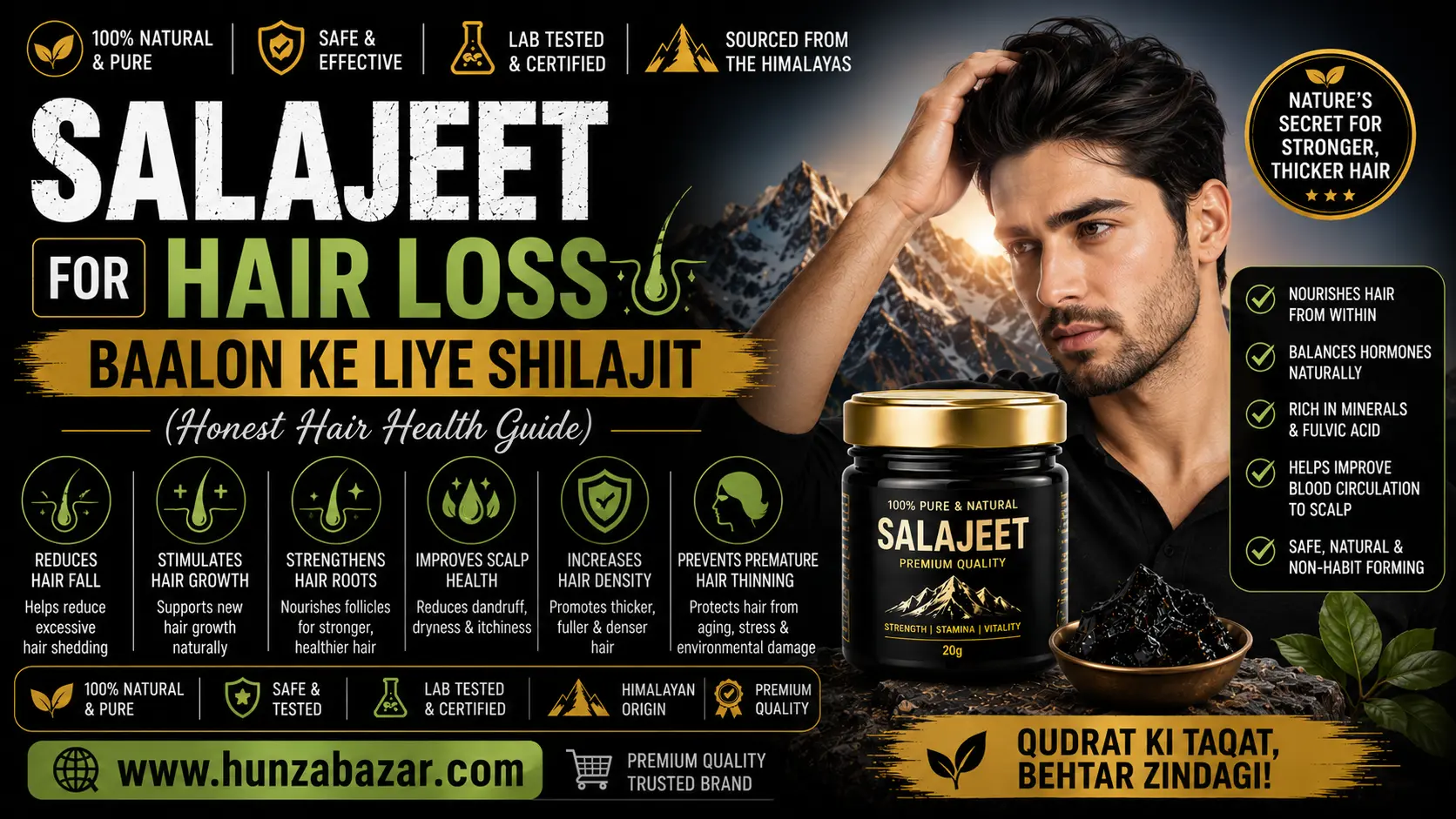
Hair fall worries almost everyone in Pakistan — men watching a hairline recede, women finding strands on the pillow. Naturally, people reach for remedies, and salajeet (shilajit) is one of the most searched. As a Gilgit-Baltistan team that sources salajeet at its origin, here's the honest answer for both men and women: salajeet can help some kinds of hair loss and not others, and the difference matters a lot. This is the hair chapter of our complete salajeet guide.
Quick answer: Salajeet provides iron, zinc and fulvic acid that may help hair if your loss is driven by nutritional deficiency, and it may support scalp circulation. It's taken internally — not applied to the hair. But it is not a cure for genetic (DHT) pattern baldness, it won't regrow lost hair, and any benefit takes about 3–6 months.
Pehle Samjhein — Aapke Baal Kyun Jhad Rahe Hain?
This is the part most articles skip, and it's the most important. Hair falls for different reasons, and salajeet only helps some of them:
Genetic pattern baldness (linked to the hormone DHT) is the biggest cause in men — about 95% of male hair loss. In women, iron deficiency is a very common driver. Other causes include stress (telogen effluvium), thyroid problems, and general nutrient gaps. Salajeet may help the nutrition and scalp-health causes — but it does little for genetic baldness. So the first real step is finding out why your hair is falling, ideally with a doctor.
⚠️ The Myth — Salajeet Khaate Hain, Baalon Par Nahi Lagate
Let's clear up a common mistake. You'll see "recipes" for salajeet hair pastes and scalp masks. The honest correction: salajeet's hair benefits come from taking it internally, not from rubbing the raw resin on your scalp.
Raw salajeet is sticky and naturally acidic, and applying raw, possibly-impure resin to your scalp isn't a studied or safe use. Ise khayein, sar par na lagayein. We cover this in detail in our salajeet topical-use myth guide.
How Salajeet May Help Hair from Within
Hair follicles need a steady supply of nutrients to build keratin and keep growing. This is where salajeet fits — and where its real (if modest) potential lies.
Its trace minerals — iron, zinc, copper and magnesium — are building blocks for healthy hair, and its fulvic acid may improve how well the body absorbs them. Salajeet may also support scalp circulation, helping follicles receive nutrients, while its antioxidant and anti-inflammatory action can ease the oxidative stress and irritation that weaken hair. The result, at best, is stronger existing hair and less nutrient-related shedding — not new hair on a bald patch.
For Women — The Iron-Deficiency Angle
For many women, hair thinning traces back to low iron (khoon ki kami). Iron is essential for the oxygen supply that follicles need, so when it's low, hair suffers — and this is exactly the kind of cause salajeet may help, thanks to its iron content and absorption-boosting fulvic acid.
One honest caution, though: don't self-treat suspected anaemia with salajeet. Get your iron levels checked first, because too much iron is harmful, and real iron deficiency needs proper treatment. For more, see our salajeet for women guide.
For Men — The DHT & Pattern-Baldness Truth
Here's where honesty matters most. Most male hair loss is genetic pattern baldness, driven by DHT shrinking the follicles. You'll see claims that salajeet "lowers DHT" — but the evidence for that is weak, and salajeet may actually raise testosterone (some of which becomes DHT). So don't expect salajeet to fight DHT baldness: it won't regrow lost hair, and it isn't a treatment for pattern baldness. For that, see a doctor about proven medical options. Our salajeet for men guide covers the testosterone side.
The good news: there's no evidence that pure salajeet causes hair loss — that worry is a myth. Used in normal doses, it supports overall hair health rather than harming it.
What About Biotin?
You'll often hear biotin and hair in the same breath. Biotin (vitamin B7) does play a role in hair, but here's the honest bit: salajeet is a mineral and fulvic-acid source, not a notable biotin source. So think of biotin as a separate piece of the puzzle — covered by a balanced diet or a dedicated supplement — and salajeet as the minerals-and-absorption piece. No single resin is a complete hair formula.
How to Take It, Results & Buying Real
Keep it simple: 300–500 mg a day — a rice-grain-sized piece — in warm (not boiling) water or milk, taken consistently. Hair grows slowly, so give it 3–6 months before judging; see our results timeline.
Only real salajeet is worth taking: genuine resin dissolves fully in warm water and bubbles without burning; fakes (coal, tar, wax) don't. Our sun-dried Aftabi salajeet is slow sun-dried to protect its fulvic acid. Avoid it if you're pregnant or breastfeeding, under 18, have an iron-overload condition, or take regular medication without a doctor's okay — and remember, untested resin can carry heavy metals.
Conclusion
Salajeet can be a genuine helper for hair when the cause is nutritional — especially low iron in women — and for general scalp health. But be honest with yourself about the cause: it won't reverse genetic baldness or regrow lost hair, and it works from the inside, gradually, over 3–6 months. Find out why your hair is falling, fix the real cause, and let pure, lab-checked salajeet support the nutrition side. Explore our pure salajeet range to begin. Zyada baal jhad rahe hon to doctor se zaroor miley.
Frequently Asked Questions
Is salajeet good for hair?
Kya salajeet baal jhadne se rokta hai?
Can I apply salajeet on my hair or scalp?
Does salajeet help DHT or male pattern baldness?
Does salajeet cause hair loss?
How long does salajeet take to help hair?
Share this post:


