
Real vs Fake Salajeet — The Bazaar Truth & Why Most Is Adulterated (Pakistan 2026)
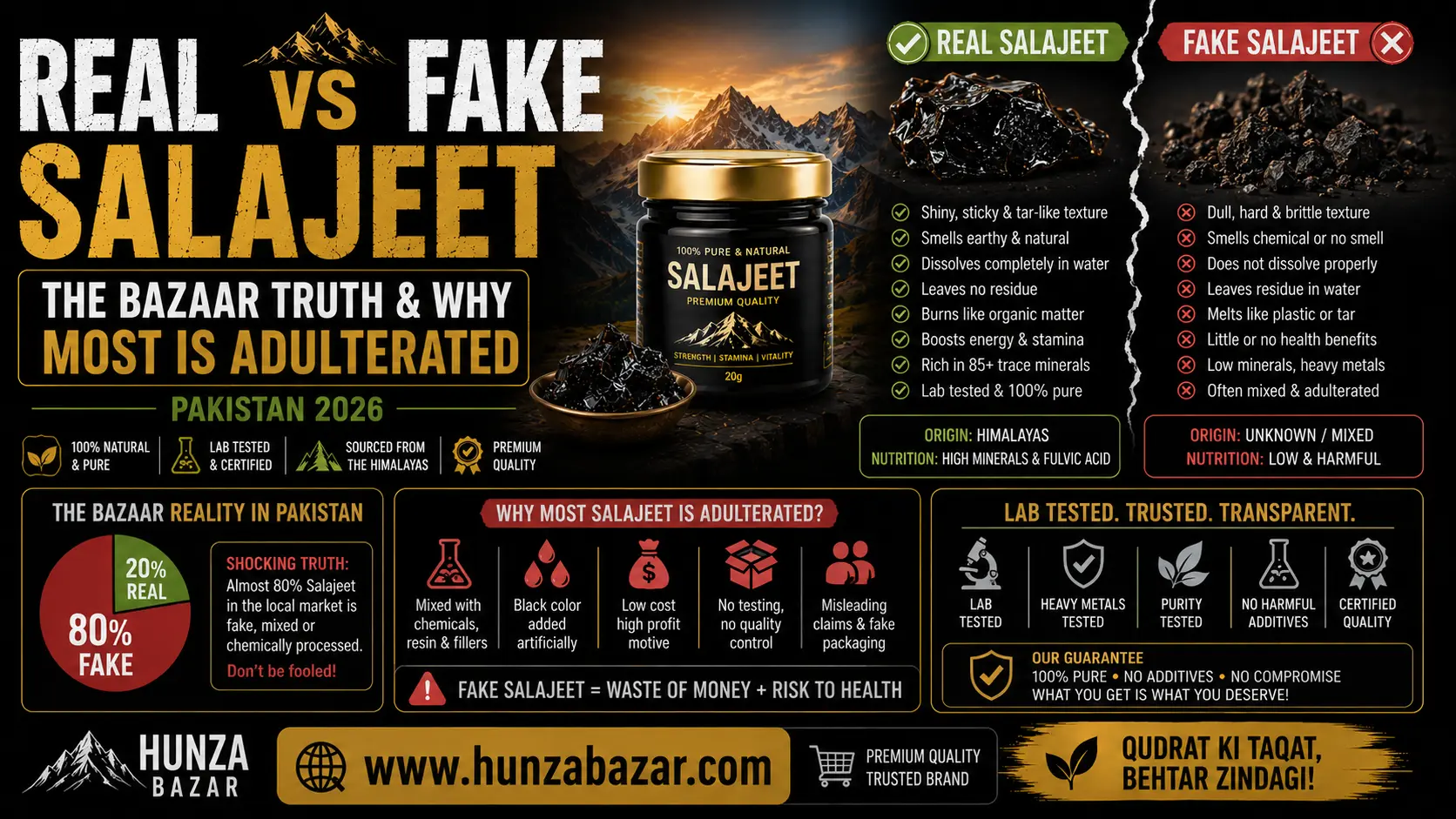
Walk through any Pakistani bazaar or scroll any marketplace and you'll see it everywhere: "100% Pure Hunza Salajeet," dirt cheap, sold by the tola. Here's the uncomfortable truth our team has to share — a large share of it isn't real salajeet at all. Behind those labels sits an open secret: tar, jaggery, coal, and sometimes things far worse. As a Gilgit-Baltistan team that sources salajeet at its origin, this is the honest exposé — why the market is flooded with fakes, what they're really made of, and the danger most sellers never mention. This is the authenticity chapter of our complete salajeet guide. (For how to test a product yourself, see our home-tests guide — here we focus on the why.)
Quick answer: Most cheaply sold salajeet in Pakistan is fake or adulterated, because real salajeet is rare and costly while fakes — made from coal tar, jaggery, cow dung and coal — cost almost nothing to produce. Worse than wasted money, these fakes can contain heavy metals and mycotoxins that harm the liver and kidneys. Only verified, lab-tested resin is safe.
Why the Market Is Flooded with Fakes — The Economics
It comes down to simple economics. Real salajeet is genuinely rare: it forms over centuries from plant matter slowly compressed between high-altitude rocks, and it's scraped by hand from remote, dangerous cliffs at 4,000–5,000 metres. Then it needs careful purification. That makes the real thing expensive to source.
Meanwhile, demand has exploded worldwide thanks to the testosterone, fertility and energy hype. When demand far outstrips a rare natural supply — and regulation is weak — the incentive to fake is enormous. A counterfeiter can mix a few rupees of cheap ingredients and sell it at a premium. That's why suspiciously cheap salajeet is almost always fake. If the price feels too good to be true, it is.
The margins make it worse: a kilo of real, lab-tested resin is costly, while a kilo of tar-and-jaggery fake costs almost nothing — yet both can be sold at similar "premium" prices to an unsuspecting buyer. That gap is the whole reason the fake trade thrives.
What Fake Salajeet Is Actually Made Of
This is the part that shocks people. Common adulterants found in fake "salajeet" include:
- Coal tar, asphalt and bitumen — oil-based, road-grade materials that mimic salajeet's dark, tar-like look. The most common base for fakes.
- Jaggery, molasses or brown sugar (gur) — cooked down to fake the sticky texture, and the reason many fakes taste sweet instead of bitter.
- Cow dung and other animal waste — yes, really; used to bulk it up and fake a "natural" earthy look and smell.
- Coal, mud, clay and sand — cheap fillers that add weight and leave gritty residue.
- Plastic polymers, wax and gums — for a pliable, resin-like feel.
- Chemical dyes and synthetic fulvic acid — to fake the colour and chemistry without the real benefits.
Mixed and moulded well, these can look convincingly like the real resin — which is exactly why so many buyers are fooled.
The "Hunza" and "Himalayan" Label Trap
Origin sells, so counterfeiters lean on it. Words like "Hunza," "Gilgit-Baltistan," "Himalayan" and "100% original" get stamped on products that have never been near a mountain — because the romance of the source is great marketing, and almost nobody checks.
The bazaar reality is that most of this is sold with no lab testing, no certificate, and no traceable source — just a confident label and a low price. And note: powder and capsules are even easier to fake than resin, because you can't see or feel what's inside, and home tests are harder to run on them. A pretty jar and a famous place-name prove nothing on their own.
The Real Danger — It's Not Just Wasted Money
If fakes were only useless, that would be bad enough. But the real concern is your health. Raw, unrefined or fake salajeet can contain heavy metals — lead, arsenic, mercury and cadmium — which seep in from mineral-rich rock or poor processing. These accumulate in the body and can cause liver and kidney damage and heavy-metal poisoning over time.
On top of that, resin that isn't properly sun-dried and stored can grow mycotoxins (mould toxins) and harbour microbes — both of which can harm the liver and gut. The World Health Organization sets strict heavy-metal limits for supplements, yet untested products routinely exceed them. So a fake isn't a harmless rip-off; it can be genuinely dangerous.
7 Red Flags of Fake Salajeet
Before the full guides, here's a quick warning-sign checklist. If a product or seller shows several of these, walk away:
- Suspiciously cheap — the single biggest red flag; real salajeet is never a bargain.
- No lab report or Certificate of Analysis — and no willingness to show one.
- A sweet taste — real salajeet is bitter; sweetness means jaggery or sugar.
- A chemical or petrol smell, or no smell at all — instead of an earthy, smoky one.
- Vague "100% original / Hunza" labels with no source, batch or testing details.
- Sold loose in bazaars with no packaging, brand or traceability.
- Burns like plastic in a flame, or leaves gritty residue in water (the home tests catch these).
None of these alone is proof, but two or three together almost always mean a fake.
How to Protect Yourself — Briefly
You don't need to be an expert, just careful. In short:
- Never buy on price alone — cheap is the single biggest red flag.
- Run the home tests as a first filter — full procedures are in our home-tests guide.
- Demand lab proof — a Certificate of Analysis or PCSIR-style report is the only thing that confirms purity and safety; see our lab-testing guide.
- Buy from transparent sources that name their origin and show testing — our buying guide walks through what to check, and our Hunza source guide shows where genuine resin actually comes from.
Why We Do It Differently
We started Hunza Bazar precisely because this market is so broken. Our Aftabi salajeet is sourced at origin in Gilgit-Baltistan, slow sun-dried to protect its fulvic acid, and lab-checked — sold with transparency instead of hype. We'd rather lose a sale to honesty than win one with a fake. Explore our full pure salajeet range, and judge it against every test in our guides.
Conclusion
The honest truth about Pakistan's salajeet market is that most of the cheap product isn't salajeet at all — it's tar, sugar, coal and worse, dressed up with a "Hunza" label. And the danger isn't just a wasted purchase; fakes can carry heavy metals and toxins that harm your health. Protect yourself the simple way: ignore bargain prices, run the home tests, insist on lab proof, and buy from a source that shows its work. Explore our pure salajeet range, sourced and tested honestly. Sasti salajeet sab se bada red flag hai — asli cheez kabhi itni sasti nahi hoti.
Frequently Asked Questions
Is most salajeet sold in Pakistan fake?
What is fake salajeet made of?
Naqli salajeet kaise banti hai?
Why is real salajeet so expensive?
Can fake salajeet be harmful?
Kya Pakistan mein asli salajeet milti hai?
Share this post:


